Villafuente’s Cursed-Root Poisoning and Pecas’s Long Imprisonment
Los renglones torcidos de DiosVillafuente’s Cursed-Root Poisoning and Freckles’s Long Imprisonment begins as a children’s encounter with a plant said to reveal the devil and ends with a living child concealed for twenty years. The episode’s horror lies in its reversals: the boy mistaken for dead survives, while the parents who claim to have buried him have instead hidden him away. His rescue eventually brings the village’s private terror into the institutions of law and the asylum.
The root and the boys
Four boys from Villafuente de Calcamar are gathering aromatic and medicinal herbs in a forest at their parents’ request. They are known as Currinche, Freckles, Adobe, and Mustafá; Adobe and Mustafá are brothers, aged nine and twelve respectively. The group has already filled several sacks with different kinds of herbs when Currinche, the expedition’s expert, starts digging near the base of a plant. He can identify herbs by name and knows their medicinal properties, and he recognizes this one as the root villagers call cursed. Its reputation is already familiar to the others, though they have not seen it before: they believe that chewing it allows a person to see the devil.
The children’s curiosity and daring overcome their fear. After tasting the root, they become disoriented and behave in ways that the adults interpret through the village’s supernatural beliefs. When their parents and other men arrive, led by Adobe, the boys’ speech is incomprehensible, their cries uncontrolled, their movements unsteady, and their eyes wild. The adults carry them back toward the village intending to seek the priest’s help with holy water and an exorcism. The episode thus places a bodily crisis beside an explanation shaped by communal fear: the children are visibly ill, but their rescuers initially understand them as possessed.
Death, concealment, and the abandoned granary
The boys do not all survive the journey home. Currinche dies before they reach Villafuente de Calcamar. Mustafá dies at dusk after severe convulsions. Freckles’s screams continue until midnight; those keeping watch over the dead hear them stop with the parish clock’s final bell. The sound appears to confirm the village’s expectation that all the children have died, but the silence conceals a different and more enduring violence.
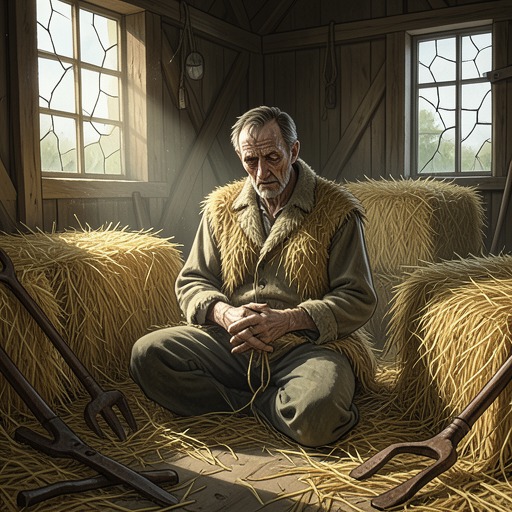
The next day, Freckles’s mother says that her husband carried their son’s corpse on his shoulders to bury him where the boy’s grandparents rest. The account is false in its crucial detail: he carried Freckles’s living body, not a corpse, and took him not to a grave but to an isolated property. Bound and gagged inside a sack, the child is brought to an abandoned granary and locked inside. His parents fear that the village will identify them as the parents of a child with the devil inside and blame them for future misfortunes. Rather than face that stigma, they choose concealment.
The concealment is not a single act but a system maintained by both parents. They take turns visiting the granary twice a week with bread, water, apples, or whatever else is available. Their visits sustain Freckles’s life while leaving him imprisoned and isolated. The account’s bluntest measure of the arrangement is his age: he is ten on the day he is locked away. What the villagers hear as the end of the children’s cries is therefore not the end of the event, but the beginning of a hidden captivity.
Discovery and rescue
Twenty years later, hunters arrive in the area seeking a guide through the forest to hunt capercaillie. They hire Adobe, now a twenty-nine-year-old man. During their journey they come upon an abandoned granary that even Adobe has never known about. When rain interrupts them, he proposes sheltering there. The small grain hatch has been nailed shut from the outside; the hunters force it open and prepare to climb down, using their lanterns to see inside.
They find a naked man crouched in the granary, with hair and beard reaching his waist and a body so malnourished that he resembles a living skeleton. The long nails on his hands and feet look like claws, and the noises, voices, and lantern light fill him with terror. The hunters abandon the shelter rather than remain with him. Once they reach safety, they report what they have seen to the first post of the Guardia Civil. The authorities return with Adobe, rescue Freckles, and report the case to a judge.
The asylum and the meaning of the episode
The judge’s first measures are to prosecute Freckles’s parents and order his admission to the asylum. The Guardia Civil brings him wrapped in a blanket to the Emergency Department directed by Dr. José Muescas. He arrives on the same day that Alice Gould has her disastrous interview with Samuel Alvar, placing the consequences of the old village secret directly beside the asylum’s present-day conflicts.
Freckles’s history exposes how an interpretation can become an instrument of harm. The root is first approached through a frightening legend; the children’s alarming condition is then treated as evidence of demonic possession; and the parents’ fear of public judgment turns that belief into a rationale for hiding their son. The story distinguishes the community’s explanation from what can be observed: the children are incapacitated, three die, and Freckles survives, but the surviving child is treated as a source of shame rather than someone needing protection. His later admission follows his rescue, yet the description of his condition makes clear that institutional arrival comes only after years of captivity.
The episode also turns an apparently completed death into a delayed discovery. The clock’s last stroke seems to close the village’s vigil, while the later opening of the granary reveals the life that the community had ceased to seek. In the asylum narrative, Freckles’s case is one of the histories that make the residents’ records and pasts consequential to Alice’s investigation: she asks the director for files to determine which residents had permission to leave the hospital on the dates of the murders she is investigating. The episode’s movement from rumor to concealment, rescue, and institutional record gives the hidden past a continuing place in the asylum’s present.